Cricket Terms Explained — 50+ Words You Must Know
Share this article
Cricket has one of the richest vocabularies of any sport. A newcomer watching their first match will hear commentators mention googlies, jaffas, cow corners, and golden ducks — and wonder whether they are watching a game or listening to a foreign language. This glossary explains over 50 cricket terms in plain language, organized by category so you can find what you need quickly. Bookmark this page and refer back to it whenever a term leaves you puzzled. For the full rules of the game, visit our complete cricket rules guide.
Batting Terms
These terms describe shots, scores, and situations that batsmen encounter at the crease.
Duck
A duck means the batsman scored zero runs before getting out. The word comes from "duck's egg" — because the number 0 looks like an egg. Scoring a duck is considered embarrassing at any level, but even the greatest players in history have collected their share. Sachin Tendulkar was dismissed for a duck 34 times in ODIs alone.
There are several varieties of duck in cricket:
- Golden Duck — dismissed on the very first ball faced
- Silver Duck — dismissed on the second ball faced
- Diamond Duck — dismissed without even facing a ball (for example, through a run-out at the non-striker's end)
- King Pair — scoring a golden duck in both innings of a Test match
Golden Duck
Getting out on the very first ball you face. A golden duck is especially painful because the batsman walks all the way to the crease, takes guard, faces one delivery, and walks right back. In T20 cricket, where every ball matters, a golden duck from a top-order batsman can change the course of a match.
Century
Scoring 100 or more runs in a single innings. A century is the gold standard of batting achievement. A double century (200 runs) is rare, and a triple century (300 runs) has been achieved only a handful of times in Test cricket. In limited-overs formats, even a single century is a match-defining effort.
Half-Century
Scoring 50 or more runs in a single innings. A half-century (also called a fifty) is a solid contribution, though batsmen who consistently get out between 50 and 99 are sometimes criticized for not converting their starts into centuries.
Chinese Cut
An inside edge that narrowly misses the stumps and runs away to the fine leg or third man area. The batsman intended to play through the off side but got an inside edge that went past the stumps — pure luck. The origin of the term "Chinese" in this context is debated and considered outdated by some, but the term remains in common cricket parlance. Also known as a "French cut" or simply an "inside edge past the stumps."
Cow Corner
The area of the field between deep mid-wicket and long-on — roughly at a 45-degree angle from the batsman on the leg side. The name supposedly comes from the fact that this area of village cricket grounds in England was where cows used to graze, since the ball rarely went there during conventional play. In modern cricket, power hitters regularly target cow corner with slog shots.
Slog
A powerful, aggressive, cross-batted shot played with maximum force and minimal technique. A slog is not elegant, but when it connects, it clears the boundary. Batsmen typically resort to slogging in the death overs of limited-overs matches when quick runs are needed. The slog sweep — a combination of the sweep and the slog — is one of the most effective scoring shots in T20 cricket.
Sweep
A shot played by getting down on one knee and sweeping the bat across the line of the ball, typically against spin bowling. The sweep sends the ball toward the leg side, usually in the fine leg or square leg region. It is an effective way to counter spin on turning pitches and is a staple shot in the arsenal of batsmen who play spin well.
Reverse Sweep
A sweep shot played in the opposite direction — toward the off side instead of the leg side. The batsman essentially switches hands on the bat handle and sweeps the ball behind the wicketkeeper or toward the third man area. It is a high-risk, high-reward shot that can disrupt a spinner's line and field placement. Some players, like Jos Buttler and Glenn Maxwell, have mastered the reverse sweep to the point where it is almost risk-free for them.
Pull Shot
A horizontal bat shot played to a short-pitched delivery on the leg side. The batsman rocks back and pulls the ball between mid-wicket and square leg. A well-timed pull shot is one of the most exhilarating sights in cricket.
Cover Drive
Considered the most elegant shot in cricket, the cover drive is played by leaning into a full-length delivery outside off stump and driving it through the covers. When a batsman plays a perfect cover drive, even the bowler sometimes stops to admire it. Check out our guide on how to play a cover drive.
Nurdle
Gently working the ball into gaps for quick singles. Nurdling is the art of rotating the strike without taking risks — essential in Test cricket and useful in the middle overs of limited-overs matches.
Bowling Terms
These terms cover the many types of deliveries and bowling tactics used in cricket.
Googly
A googly is a leg-spinner's secret weapon. While a standard leg-spin delivery turns from right to left (away from a right-handed batsman), a googly turns the opposite way — from left to right, into the right-handed batsman. The googly is bowled with a different wrist position, and when disguised well, it can completely deceive the batsman. The delivery was invented by Bosanquet in the early 1900s and has been a part of every leg-spinner's toolkit ever since. Shane Warne's googlies were nearly impossible to pick.
Yorker
A full-length delivery aimed at the base of the stumps, right at the batsman's toes. The yorker is one of the most difficult deliveries to score off because the batsman has almost no room to swing the bat. The name is believed to come from Yorkshire, where bowlers were particularly skilled at bowling this delivery. In T20 cricket, a well-executed yorker at the death is worth its weight in gold. Lasith Malinga and Jasprit Bumrah are considered masters of the yorker. Learn how to bowl one with our yorker bowling guide.
Jaffa
An unplayable delivery — one that is so perfectly bowled in terms of line, length, swing, or seam movement that the batsman has virtually no chance of playing it. When a commentator says "that's a jaffa," they mean the ball was exceptional. The origin of the word is debated: some believe it comes from the Jaffa orange (something sweet and perfectly round), while others trace it to Australian slang. Also called a "peach" or a "ripper."
Doosra
An off-spinner's delivery that turns away from a right-handed batsman instead of turning into them. The word "doosra" means "the other one" in Hindi and Urdu, and the delivery was popularized by Saqlain Mushtaq of Pakistan in the late 1990s. Muttiah Muralitharan also bowled a devastating doosra.
Is the doosra banned in cricket? The doosra itself is not banned, but it is extremely difficult to bowl without bending the elbow beyond the legal 15-degree limit set by the ICC. Most bowlers who regularly bowled the doosra — including Muralitharan and Saeed Ajmal — faced scrutiny over their bowling actions. Ajmal was suspended in 2014 after biomechanical testing revealed his elbow extension exceeded the limit. In practice, the doosra has largely disappeared from international cricket because very few bowlers can deliver it with a legal action. Learn more in our doosra bowling guide.
Bouncer
A short-pitched delivery aimed at the batsman's head or chest. The ball bounces well before reaching the batsman and rises sharply. Bouncers are used as an intimidation tactic and to set up other deliveries. Fast bowlers like Mitchell Johnson and Jofra Archer have made careers out of hostile bouncer spells. Read our guide on how to bowl a bouncer.
Is 2 bouncers allowed in IPL? In T20 Internationals and the IPL, the current rule allows one bouncer per over (a bouncer is defined as a delivery that passes or would have passed above shoulder height of the striker standing upright at the crease). In ODIs, the limit is two bouncers per over. In Test cricket, there is no limit on bouncers per over, though umpires can intervene under the "dangerous and unfair bowling" law if the bowling becomes excessively hostile. See our wide ball rules guide for more on bowling regulations.
Four Types of Spin Bowling
Spin bowling comes in four main varieties:
- Leg Spin — bowled by a right-arm wrist spinner. The ball turns from right to left (away from a right-handed batsman). Shane Warne was the greatest leg-spinner of all time. Learn to bowl leg spin.
- Off Spin — bowled by a right-arm finger spinner. The ball turns from left to right (into a right-handed batsman). Ravichandran Ashwin and Nathan Lyon are modern masters. Learn to bowl off spin.
- Left-Arm Orthodox — the left-arm equivalent of off spin. The ball turns from right to left (into a right-handed batsman). Ravindra Jadeja and Axar Patel bowl this style.
- Left-Arm Wrist Spin (Chinaman) — the left-arm equivalent of leg spin. The ball turns from left to right (away from a right-handed batsman). This is the rarest form of spin bowling. Kuldeep Yadav is the most prominent current example.
Donkey Drop
A very slow, high-arcing delivery that loops up into the air before dropping on or near the stumps. The donkey drop is rarely used in professional cricket, but when it works, it catches the batsman completely off guard. The exaggerated flight gives the ball extra dip and can beat a batsman who charges down the pitch expecting a normal-length delivery.
Knuckleball
A slower delivery where the bowler grips the ball with the knuckles rather than the fingertips. The knuckleball wobbles in the air and arrives much slower than the batsman expects. It has become increasingly popular in T20 cricket as a death-over variation. Learn how to bowl one with our knuckleball guide.
Full Toss
A delivery that reaches the batsman without bouncing. A full toss is generally considered a bad ball and easy to hit, unless it is deliberately bowled as a slower-ball variation. A full toss above waist height is called a no-ball (a beamer if aimed at the head).
Beamer
A full toss aimed at the batsman's head. Beamers are dangerous and illegal. The umpire will issue a warning to the bowler for the first beamer, and the bowler will be removed from the attack if they bowl a second one in the same innings.
Fielding Terms
Cricket has some of the most colorful fielding position names in all of sport.
Silly Point
A fielding position very close to the batsman on the off side, just in front of the bat. The "silly" prefix means dangerously close — the fielder at silly point is within a few meters of the batsman and wears a helmet and shin pads for protection. Silly mid-off and silly mid-on are similar close-in positions on either side of the pitch.
Slip
One or more fielders standing behind the batsman on the off side, positioned to catch edges. First slip is closest to the wicketkeeper, second slip is next, and so on. A "slip cordon" of three or four fielders is common in Test cricket when the ball is swinging or seaming. For a full breakdown of all positions, see our cricket field positions guide.
Gully
A fielding position between the slips and point, at roughly a 45-degree angle behind the batsman on the off side. The gully fielder catches balls that fly off the bat at a wider angle than the slip fielders would cover.
Third Man
A fielding position behind the wicketkeeper on the off side, near the boundary. Third man catches edges and deflections that go fine past the slips and is a key position in limited-overs cricket.
Fine Leg
The leg-side equivalent of third man — a fielding position behind the wicketkeeper on the leg side, near the boundary. Fine leg collects balls that are glanced, swept, or edged to the leg side.
Long On and Long Off
Boundary fielders positioned straight behind the bowler. Long on is on the leg side of the straight line, and long off is on the off side. These fielders are placed to prevent straight drives from reaching the boundary.
Stumping
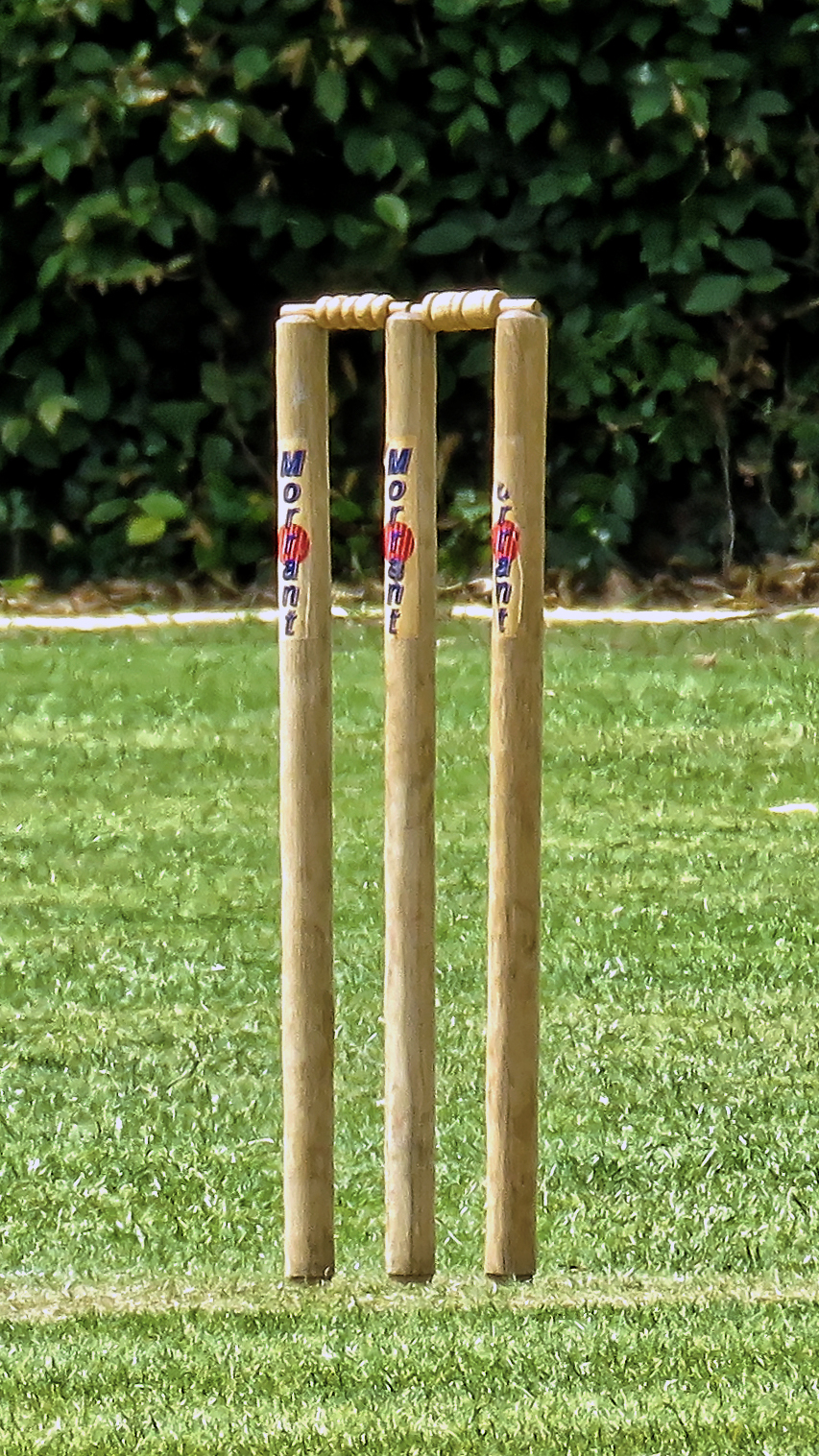
A method of dismissal where the wicketkeeper collects the ball and removes the bails while the batsman is outside their crease. Stumpings typically occur against spin bowling, when the batsman advances down the pitch to play the ball and misses. MS Dhoni holds the record for the most stumpings in ODI cricket with 38 dismissals.
General Terms
These terms cover rules, situations, and cricket culture that do not fit neatly into batting, bowling, or fielding categories.
Powerplay
A set of overs at the beginning (and sometimes middle) of a limited-overs innings during which fielding restrictions apply. During the powerplay, only a limited number of fielders are allowed outside the inner circle, making it easier for batsmen to score boundaries. Different formats have different powerplay rules. In T20 cricket, the powerplay is the first 6 overs. In ODIs, the powerplay is the first 10 overs.
Free Hit
A delivery following a no-ball (specifically a front-foot no-ball) on which the batsman cannot be dismissed by most conventional methods. The free hit rule was introduced to increase the penalty for bowling no-balls and has become one of the most exciting moments in limited-overs cricket.
DLS Method
The Duckworth-Lewis-Stern method is a mathematical formula used to calculate revised targets in rain-interrupted limited-overs matches. When rain shortens a match, DLS sets a fair target for the team batting second based on the resources (overs and wickets) available. Read our full DLS method explainer.
Follow-On
In Test cricket, if the team batting first scores significantly more runs than the team batting second (by 200 runs in a five-day match), the batting-first captain can ask the other team to bat again immediately — this is called enforcing the follow-on. It is a strategic decision that can save time and press for victory. Learn the exact thresholds in our follow-on rules guide.
Pencil Cricket
A popular paper-and-pencil game played in Indian schools and colleges. Players draw a set of outcomes (runs, wicket, wide, no ball, dot ball) on a piece of paper, place a pencil on it, spin the pencil, and whatever the tip points to becomes the result of that ball. Pencil cricket has been a beloved pastime for generations of Indian students who could not get access to a proper cricket ground during school hours. Variations include assigning different probabilities to different outcomes and playing full innings with run chases.
Is Number 69 Banned in Cricket?
No, the number 69 is not banned in cricket. However, it is rarely chosen as a jersey number by professional cricketers due to its double meaning. Most cricket boards do not have an explicit rule against any jersey number, but players tend to avoid it out of personal preference. There is no ICC regulation that prohibits any specific number.
Can Two Wickets Fall on One Ball?
Yes, it is possible for two wickets to fall on a single delivery, though it is exceptionally rare. The most common scenario is: the bowler bowls a delivery that dismisses the batsman (caught, bowled, LBW, etc.), and during the confusion or while attempting a run, the other batsman is run out. In this case, the first dismissal is credited to the bowler, and the run-out is recorded as the second dismissal. The incoming batsman takes the crease of the run-out batsman.
Mankad (Run-Out at Non-Striker's End)
Named after Indian cricketer Vinoo Mankad, a Mankad occurs when the bowler runs out the non-striker for backing up too far before the ball is delivered. Once controversial, it was officially classified as a standard run-out by the ICC in 2022 and is now called simply a "run-out at the non-striker's end." The MCC updated the laws to remove any stigma from this form of dismissal.
All-Rounder
A player who contributes significantly with both bat and ball. True all-rounders are rare and extremely valuable — they effectively give a team an extra option in both departments. Players like Ben Stokes, Ravindra Jadeja, and Hardik Pandya are classified as all-rounders.
Nightwatchman
A lower-order batsman sent in to bat near the end of a day's play in Test cricket to protect a more skilled batsman from having to bat in difficult conditions. The nightwatchman's job is simply to survive until stumps (close of play) so the key batsman can resume the next morning in better light.
Tail-Ender
A batsman who bats in the lower order (typically positions 8 to 11) and is primarily in the team for their bowling or wicketkeeping ability. When commentators say "the tail is in," it means the specialist batsmen are all out and the less skilled batsmen are at the crease.
Quick Reference Table
| Term | Meaning |
|---|---|
| Duck | Out for 0 runs |
| Golden Duck | Out on first ball |
| Century | 100 runs in one innings |
| Googly | Leg-spin that turns the wrong way |
| Yorker | Full ball aimed at the toes |
| Jaffa | An unplayable delivery |
| Doosra | Off-spin that turns away |
| Bouncer | Short ball aimed at head/chest |
| Cow Corner | Between deep mid-wicket and long-on |
| Chinese Cut | Inside edge past the stumps |
| Slog | Powerful cross-batted hit |
| Donkey Drop | Very slow, looping delivery |
| Silly Point | Close-in fielding position |
| Stumping | Keeper breaks stumps while batsman is out of crease |
| Powerplay | Overs with fielding restrictions |
| Free Hit | Cannot be dismissed (after no-ball) |
| DLS | Rain-revised target formula |
| Follow-On | Forced to bat again immediately |
| Mankad | Run-out at non-striker's end |
| Nightwatchman | Lower-order batsman protecting a key player |
Wrapping Up
Cricket's vocabulary is part of what makes the sport so unique and endlessly fascinating. Whether you are a newcomer trying to understand commentary or a lifelong fan looking up an obscure term, this glossary covers the essentials and beyond. Every term here has a story behind it — a reason it was coined, a match where it became famous, or a rule change that gave it new significance.
For deeper dives into specific rules, explore our guides on wide ball rules, free hit rules, powerplay rules, and the full cricket glossary. And if you are just starting your cricket journey, welcome — you have picked the right sport.
Share this article
Rahul Sharma
Expert in: Cricket RulesRahul Sharma has played district-level cricket in Mumbai for 8 years and has personally tested more than 50 bats, pads, gloves, and helmets across different price ranges. He joined CricJosh to help Indian club cricketers make smarter equipment choices without overpaying. His reviews are based on real match and net session use, not sponsored samples.
Why trust this review: Rahul has used every product in this review across multiple match and net sessions before writing a word. He buys equipment at retail price and accepts no free samples.
Related Articles


13 min read · 1 May 2026
14 min read · 1 May 2026